
|
||||
| Prev |
 Guatemala 2000 A photo journal by David Booth |
Next | ||
|
|
||||
|
|
||||
| Prev |
Guatemala 2000 A photo journal by David Booth |
Next | ||
|
|
||||
Later in the afternoon we walked to the Metropolitan Cathedral at the square by the central market. In front of the cathedral is a column commemorating some of the thousands of civilians who were "disappeared" during Guatemala's 36-year civil war. Most of them perished during the1980s under Guatemalan president Rios Montt's military rule. The US Reagan administration heavily supported the Guatemalan military with arms and training during this period. In spite of Rios Montt's implication in some of Guatemala's worst human rights abuses, Montt was elected as leader of the Guatemalan congress in 2000. This is one of the many bizarre twists in Guatemala's complex political situation.
In the evening, a few of us took a short walk as a group, although we were warned not to venture out into the street at night. Guatemala City is very dangerous at night. The extremely high crime rate is fueled by the 36-year history of civil war, the breakdown of social structures, the huge numbers of guns that remain in the hands of the population, and the poverty.
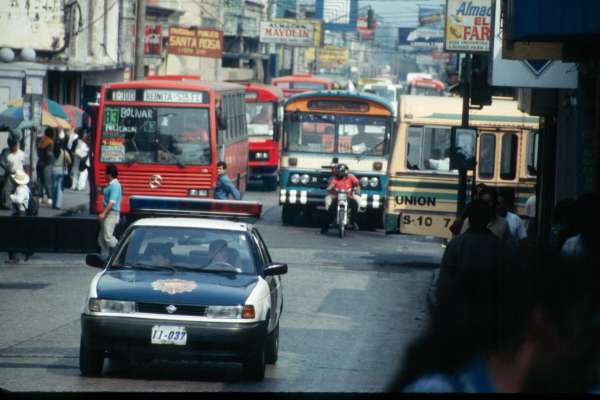 A street near the central market in Guatemala City. I have never seen so many
buses in my life.
A street near the central market in Guatemala City. I have never seen so many
buses in my life.
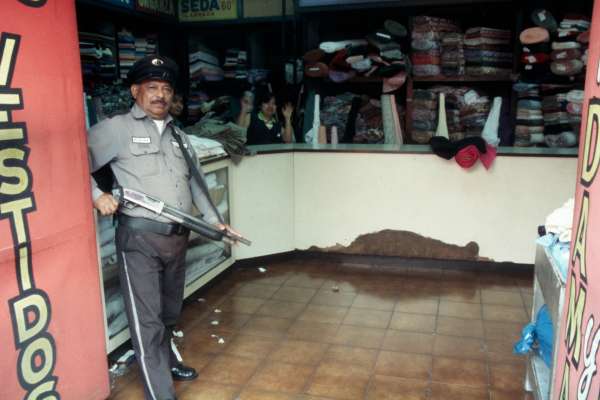 A security officer guards the entrance of a fabric store near the central
market with his pump-action, sawed-off shotgun. This was a common sight.
A security officer guards the entrance of a fabric store near the central
market with his pump-action, sawed-off shotgun. This was a common sight.
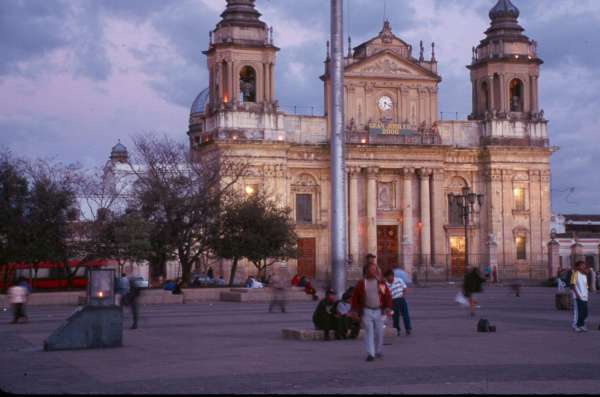 The Metropolitan Cathedral near the central market in Guatemala City. On the
left foreground you can see the eternal flame of the Monument for Peace.
The Metropolitan Cathedral near the central market in Guatemala City. On the
left foreground you can see the eternal flame of the Monument for Peace.
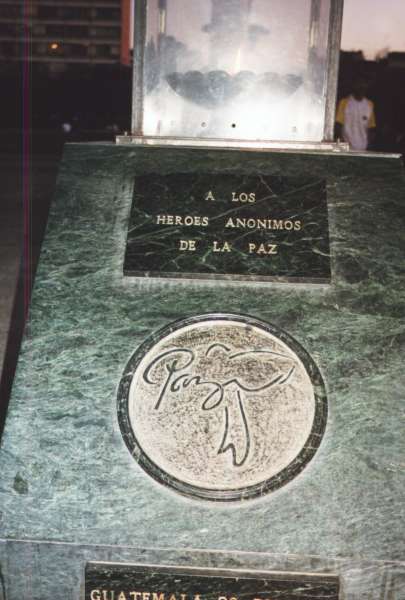 Detail of the Monument for Peace,
commemorating the signing of the Guatemalan peace accords on December 29, 1996. The inscription at the top says
(translated): "To the anonymous heroes of peace".
[Photo by Meghan.]
Detail of the Monument for Peace,
commemorating the signing of the Guatemalan peace accords on December 29, 1996. The inscription at the top says
(translated): "To the anonymous heroes of peace".
[Photo by Meghan.]
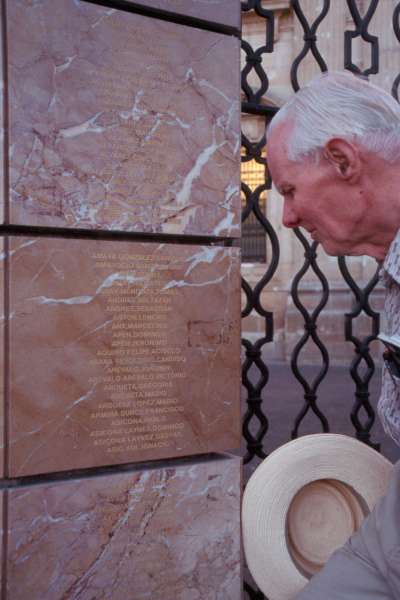 Outside the Metropolitan Cathedral, my dad views a column commemorating the "disappeared".
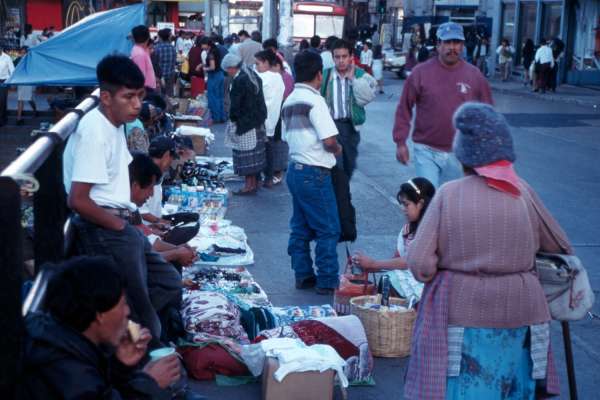 Street vendors outside the central market.
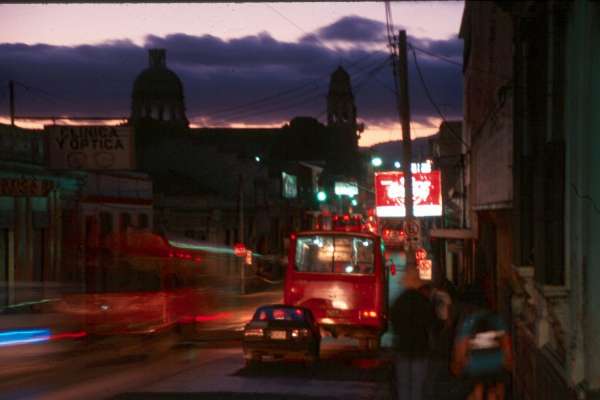 A street near our hostel in the evening.